Sustainability & Climate Intelligence
From Sustainability Obligations to Measurable Enterprise Value.
Connect ESG performance, carbon accounting, climate risk, reporting and sustainable finance through one governed sustainability intelligence model.
- Measure
- Govern
- Report
- Decarbonise
- Manage risk
- Finance
- Decide
Governance & assurance surrounds every layer
- ESG performanceTrack material performance, targets and accountability.
- Carbon accountingGovern Scope 1, Scope 2 and relevant Scope 3 activity and calculations.
- Climate & portfolio riskConnect physical, transition and configured environmental and social risk views.
- Capital & decisionsRelate transition priorities, sustainable finance and executive action.
Sustainability Is Now a Business Discipline.
The new reality
The challenge is no longer producing another report. It is governing sustainability data, performance, risk and decisions across a complex enterprise.
What is driving it
Reporting landscape, mapped where implemented
How framework mapping worksCurrent state
- Fragmented collection
- Manual calculations
- Inconsistent KPIs
- Weak visibility
- Difficult evidence trails
With CONSOLYX
- Governed data
- Controlled calculations
- Risk visibility
- Decision intelligence
- Trusted reporting
Most organisations have sustainability data. Few have sustainability intelligence.
One Governed Model for Performance, Targets and Accountability.
Sustainability performance
Manage environmental, social and governance indicators through one controlled data, target and performance model rather than separate reporting silos.
- Data
- KPI
- Target
- Performance
- Evidence
- Action
Environmental
- Energy
- Water
- Waste
- Biodiversity
- Emissions
- Configured material indicators
Social
- Workforce
- Health & safety
- Training
- Community
- Configured social indicators
Governance
- Risk
- Oversight
- Policies
- Ethics
- Configured governance indicators
Reuse approved supplier, workforce, utility, procurement and finance data from Enterprise Operations and Financial Intelligence where relevant, rather than rebuilding sustainability data in isolation.
Enterprise Operations Financial IntelligenceAIAsk the ESG assistant why a KPI moved or which targets are off track; it reads the approved KPI values and cannot change them.
Controlled Data. Controlled Factors. Defensible Emissions.
Carbon accounting intelligence
Turn governed operational activity into traceable Scope 1, Scope 2 and relevant Scope 3 emissions information, with controlled factors, boundaries, review and reduction tracking.
- Activity data
- Factor
- Calculation
- Review
- Emissions
- Target
- Action
Scope 1
Direct emissions from owned or controlled sources.
Scope 2
Indirect emissions associated with purchased energy.
Scope 3
Relevant value-chain categories within the implemented scope, with coverage shown across all fifteen.
Controls
Emission factors
Source-cited, effective-dated and approved; superseded factors stay on record.
Factor checks
A calculation stops on a missing, unapproved, expired or unit-mismatched factor instead of using zero.
Organisational boundaries
Operational control, financial control or equity share, from the group structure.
Baselines & targets
Baseline year, glide path and progress for every target.
Calculation trace
Each result keeps its activity records, factor, method version and calculation basis.
Reduction tracking
Actual reductions against the target path and the action plan.
Bring energy, fuel, water, procurement, commuting and workforce activity across from Enterprise Operations instead of re-keying it; the rows still pass ESG validation and approval.
Enterprise OperationsAIAsk where emissions are concentrated or how a figure was calculated; factors, calculations and approved results stay governed.
Turn Climate Exposure Into Business Intelligence.
Climate intelligence
Assess how physical hazards and the transition to a lower-carbon economy may affect facilities, assets, operations, finance and strategic choices.
- Hazard / driver
- Exposure
- Business or financial impact
- Scenario
- Response
Physical risk
Transition risk
Physical and transition risks are recorded in a governed register and scored on likelihood and impact, with opportunities, actions and net-zero progress alongside.
Scenario view, on management assumptions by temperature pathway
- 1.5°C
- 2°C
- 3°C
- 4°C
Scenario impacts are expressed in revenue, cost, asset, cash-flow and NPV terms, so climate exposure reads in the same language as the group’s finances.
Financial IntelligenceAIThe ESG assistant explains exposures and compares scenarios from the register; it does not forecast climate events or predict losses.
Bring Environmental, Social and Climate Risk Into Governed Decisions.
Sustainability & portfolio risk
Extend sustainability intelligence into configured risk assessment for counterparties, projects, assets or portfolios, particularly where financial-services, leasing, investment or project decisions require structured environmental and social review.
- Screen
- Assess
- Review
- Clear
- Follow up
ESRM screening
Structured environmental and social screening inside governed workflows.
Risk assessment
Configured criteria, weights, bands and thresholds; methodologies are versioned, not hard-coded.
Portfolio view
Compare exposure across counterparties, projects, assets or portfolios.
Risk scoring
Configured scoring only; every score breaks down to component, question, answer and evidence.
Evidence & decisions
Clearance, conditions, action plans and decision history, with maker and reviewer kept apart.
AIThe ESG assistant can explain how an assessment score was built; it never sets a score, and the configured methodology and approval stay explicit.
Connect Decarbonisation to Capital Decisions.
From carbon to capital
Move beyond carbon inventory by connecting reduction priorities, residual carbon management and sustainability performance to financing and investment decisions.
- Measure
- Reduce
- Track
- Manage residual exposure
- Finance transition
Carbon assets & credits
Track reduction projects, verified reductions and the credits held, reserved or retired.
Valuation is indicative, not a trading quote; registry references are recorded, not connected.
Climate & sustainable finance
Record climate and transition finance against the projects it funds.
- Green and transition finance eligibility
- Taxonomy alignment
- Climate capex and funding required
- Transition programmes
Capital context
Carbon-tax, compliance and climate capex and opex impacts are expressed in EBITDA, profit and cash-flow terms, so transition priorities can sit beside budgets and investment cases in Financial Intelligence.
Financial IntelligenceAIAsk which reduction projects are behind plan or where an offset shortfall sits; the assistant gives no market valuation or investment advice.
Map Once. Govern the Evidence. Report to the Relevant Requirement.
Reporting & disclosure intelligence
Turn governed sustainability data into controlled reporting and disclosure outputs for management, boards, investors, assurance stakeholders and applicable reporting requirements.
Framework mapping
Map governed metrics and evidence to the frameworks a group adopts, with coverage, gaps and readiness.
Reporting packs
Sustainability, carbon, climate and executive packs, exported to PDF, PowerPoint or Excel.
Regulatory & external outputs
Produced for the jurisdictions and reporting scope configured for the group.
Lineage
The route from source data through calculation and approval to disclosure.
Integrated reporting context
Revenue and group structure from Financial Intelligence for intensity metrics and reporting boundaries.
AIAsk which disclosures still have gaps against the mapped frameworks; report commentary stays reviewable and separate from approved figures.
Numbers That Withstand Scrutiny.
The trust layer
Make ownership, validation, approval, methodology, evidence and lineage part of the sustainability data chain before figures become trusted reports or decisions.
- Capture
- Validate
- Approve
- Report
- Assure
Ownership
Named responsibility for data and review.
Evidence
Supporting source documentation retained with the governed record.
Approvals
Maker, checker and approver sign-off before publication, where configured.
Lineage & versioning
Trace any figure to its source records, factor and formula; factor and method versions and period freeze keep every change on record.
Assurance readiness
Framework, disclosure, evidence and assurance readiness organised for internal and external review.
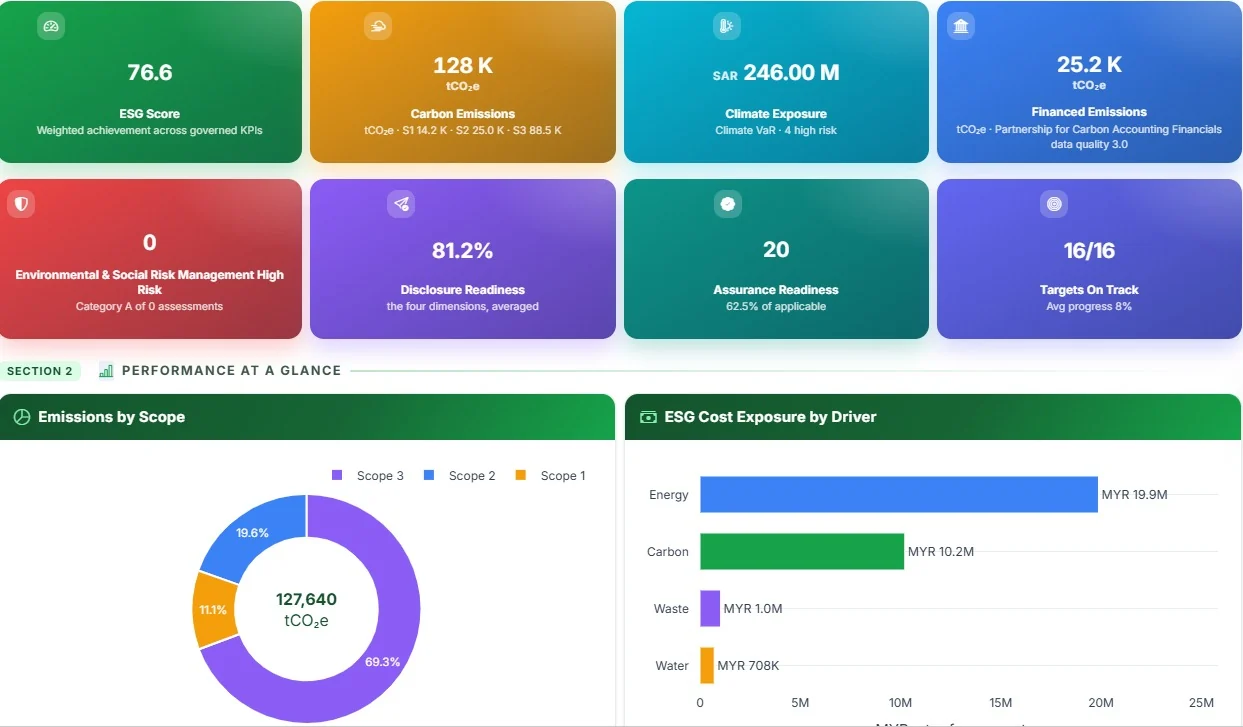
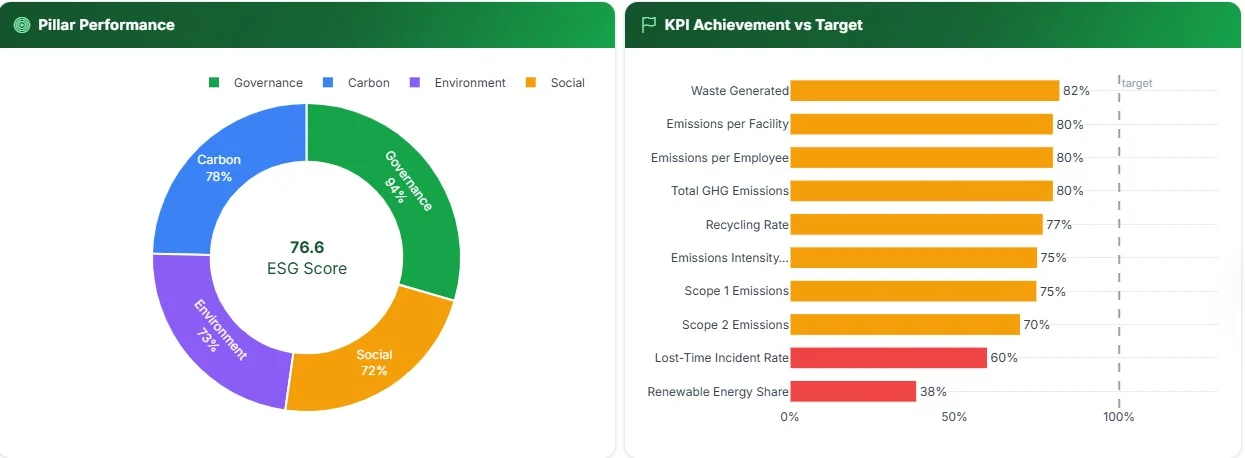
Ask. Explain. Anticipate. Prioritise.
AI sustainability intelligence
Use natural-language questions and governed AI assistance to explore authorised sustainability, carbon, climate and risk information with context that points back to controlled source data.
Ask
Which facilities are driving emissions growth?
Explain
Where are we missing sustainability targets?
Anticipate
Which climate exposures require management attention?
Prioritise
Which configured portfolio risks require review?
How the assistant works
- Answers from the platform’s own carbon, target, climate, ESRM and framework engines
- Shows its sources with every answer
- Stays inside the user’s authorised group
- Read-only: it cannot change data, factors or approvals
- Charts, follow-up questions and export to PDF, PowerPoint or Excel
Forecasts, benchmarks and alerts elsewhere in the module are calculated by defined statistical rules, not generated text.
Generated answers are shown apart from approved metrics and never become the reported figure, a regulatory conclusion or investment advice.
Turn Sustainability Intelligence Into Executive Action.
Executive & board intelligence
Bring performance, targets, carbon, climate risk, transition priorities, sustainable finance and accountable actions into decision-ready executive views.
Performance
Material KPIs, progress and targets.
Carbon & transition
Emissions, reduction trajectory and transition actions.
Risk
Physical, transition and configured portfolio or ESRM exposure.
Capital
Relevant finance, investment and transition funding context.
Actions
Ownership, exceptions, priorities and follow-through.
Packs, exported to PDF, PowerPoint or Excel
One Governed Sustainability Model Across Industries and Jurisdictions.
Built for enterprise sustainability
Configure the sustainability intelligence foundation around different operating models, sectors, entities, locations, reporting requirements and governance needs without creating a separate platform for every market.
Scale
Multi-entity, multi-country and group, node, facility and location structures.
Configure
Industry KPIs, frameworks, emission factors, risk methods, workflows and local requirements.
Trust
Governed data, traceable calculations, controlled reporting and assurance-ready evidence.
Industry examples
Country-agnostic does not mean regulation-agnostic: jurisdiction-specific reporting is published only where it is configured and validated.
Move Beyond Disclosure. Manage Performance, Risk and Value.
From obligation to enterprise value
Use one governed sustainability intelligence foundation to connect reporting obligations with operational performance, financial context, decarbonisation, risk, capital and executive decisions.
- From Reporting obligation
- To Sustainability intelligence
- From Carbon inventory
- To Decarbonisation decisions
- From Climate exposure
- To Resilience & response
- From Sustainability data
- To Enterprise intelligence
A walkthrough shaped around your entities, frameworks and risk methods.
info@co-iv.com