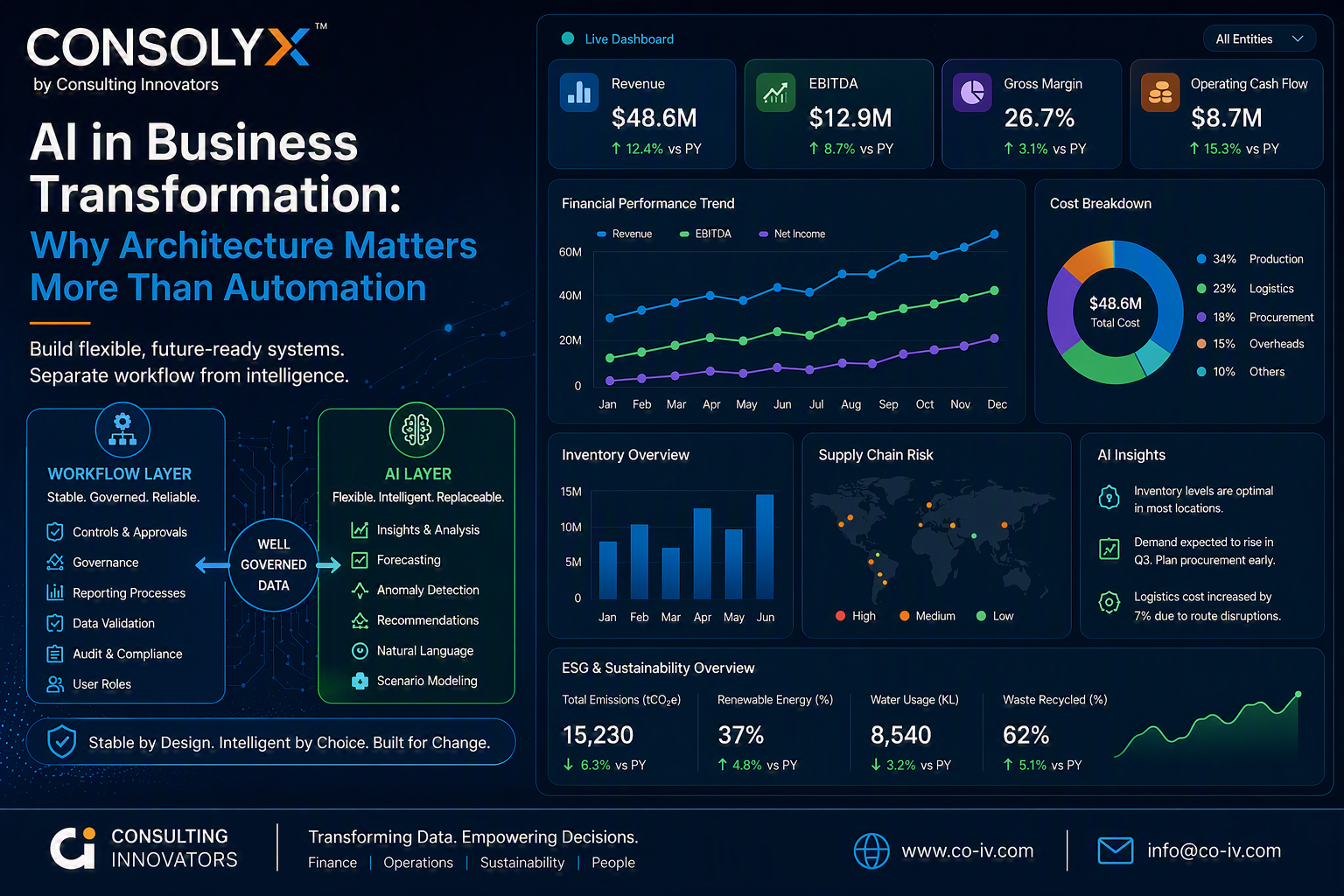
AI in Business Transformation: Why Architecture Matters More Than Automation
AI adoption is accelerating, but many organizations are asking the wrong question. The real challenge is not how to implement AI, but how to design systems that remain flexible as models evolve. This article explores how separating business workflows from AI layers can prevent lock-in and enable scalable, future-ready transformation.
AI in Business Transformation: The Real Opportunity Lies Beyond Automation
Over the last few years, AI has become part of almost every business conversation.
Boards are asking about it. Finance teams are exploring it. Technology leaders are under pressure to implement it. Software vendors are embedding it into every product.
But many organizations are still starting with the wrong question.
The usual question is:
“How do we implement AI in our business?”
A more important question is:
“How do we design our systems so AI can improve over time without forcing us to rebuild everything?”
This shift in thinking may seem small, but it has a major impact on long-term success.
Why Traditional Transformation Thinking Still Matters
Business transformation—whether in finance, manufacturing, or supply chain—is never a quick exercise. It takes time to define workflows, build controls, implement approvals, align reporting structures, and ensure compliance.
Once these systems are in place, changing them becomes expensive and disruptive.
This is why organizations must be careful not to rush AI into their operations without thinking about long-term flexibility.
The Real Issue: How AI Is Being Used
AI itself is not the problem.
The challenge lies in how it is being embedded.
Many companies are building their workflows around a specific model, vendor, or platform. They design dashboards, reporting structures, and decision-making processes tightly linked to that choice.
This approach may deliver quick results, but it creates long-term risk.
AI models are evolving rapidly:
- New models are released frequently
- Costs and pricing structures change
- Performance varies across use cases
- Security and compliance expectations continue to evolve
A model that works well today may not remain the best fit tomorrow.
If systems are built too tightly around one model, changing later becomes costly and complex. This creates a new kind of dependency — AI lock-in.
A Better Approach: Separate Workflow from Intelligence
A more sustainable approach is to treat AI as a flexible component rather than the foundation of the system.
Organizations should design two distinct layers:
1. The Workflow Layer (Stable and Controlled)
This layer defines how the business operates:
- approvals
- controls
- reporting processes
- data validation
- review cycles
- dashboards
- user roles
- audit trails
- governance structure
This part should remain stable, structured, and aligned with company policies.
The AI Layer (Flexible and Replaceable)
This layer provides intelligence:
- analysis and commentary
- variance explanations
- forecasting support
- anomaly detection
- recommendations
- inventory insights
- ESG and carbon analysis
- HR trend identification
This layer should be adaptable. It must allow businesses to improve, upgrade, or replace models without affecting the underlying workflow.
Why This Matters for Manufacturing and Operations
This concept is not limited to finance.
In manufacturing and supply chain environments, most organizations already have multiple systems:
- ERP systems
- spreadsheets
- plant systems
- procurement tools
- warehouse management systems
The real problem is not lack of data — it is fragmentation.
Because of this:
- decision-makers lack real-time visibility
- inventory issues are identified too late
- supply chain risks are not detected early
- cost inefficiencies remain hidden
- ESG and sustainability metrics are difficult to track
- finance teams spend more time collecting data than analyzing it
This is where AI can create real impact—but only when supported by the right architecture.
From Reactive Reporting to Real-Time Decision Making
When workflows are well structured and connected, AI can help organizations:
- detect issues earlier
- generate insights instantly
- improve forecasting accuracy
- optimize inventory levels
- reduce operational costs
- enhance sustainability tracking
- support better workforce planning
However, if AI is simply added on top of disconnected systems, it becomes another tool instead of a solution.
The Role of Modern Business Platforms
Modern platforms must move beyond static reporting.
Across areas such as:
- financial consolidation
- management reporting
- ESG and sustainability
- carbon accounting
- inventory analytics
- HR analytics
the real value lies in creating an integrated system where:
- data is unified across sources
- business logic is controlled and transparent
- reporting is available in real time
- AI enhances insights and recommendations
- leadership can act faster
- the intelligence layer evolves with time
This means businesses should avoid relying entirely on one model or vendor. Instead, they should design systems where the process remains consistent while the intelligence improves continuously.
Key Questions for Business Leaders
Before implementing AI initiatives, organizations should carefully evaluate:
Can the workflow continue if the AI model changes?
If not, the system may be too dependent on one provider.
Who controls the business logic?
The organization—not the vendor—should define processes and decision flows.
Can AI capabilities be upgraded without redesigning the system?
Flexibility is essential for long-term success.
Are governance and compliance fully addressed?
Explainability and auditability are critical, especially in finance and ESG reporting.
Is AI solving a real business problem?
AI should improve efficiency, insight, and decision-making—not just add features.
The Future Is About Architecture, Not Just AI
Today, much attention is focused on comparing models:
- which is faster
- which is more accurate
- which is more cost-effective
While these factors matter, they should not drive long-term transformation decisions.
The more important question is:
Will your system still work effectively as AI technology evolves?
Organizations that build flexible architectures will be able to:
- adopt better models
- adapt to regulatory changes
- control costs
- improve decision-making continuously
Conclusion
AI should not be treated as a one-time implementation.
It should be viewed as a continuously evolving capability.
The real competitive advantage will not come from selecting the best model today.
It will come from designing systems that remain flexible, scalable, and future-ready.
Businesses that separate workflow from intelligence will be better positioned to adapt, innovate, and grow without constant disruption.
That is where real transformation begins.