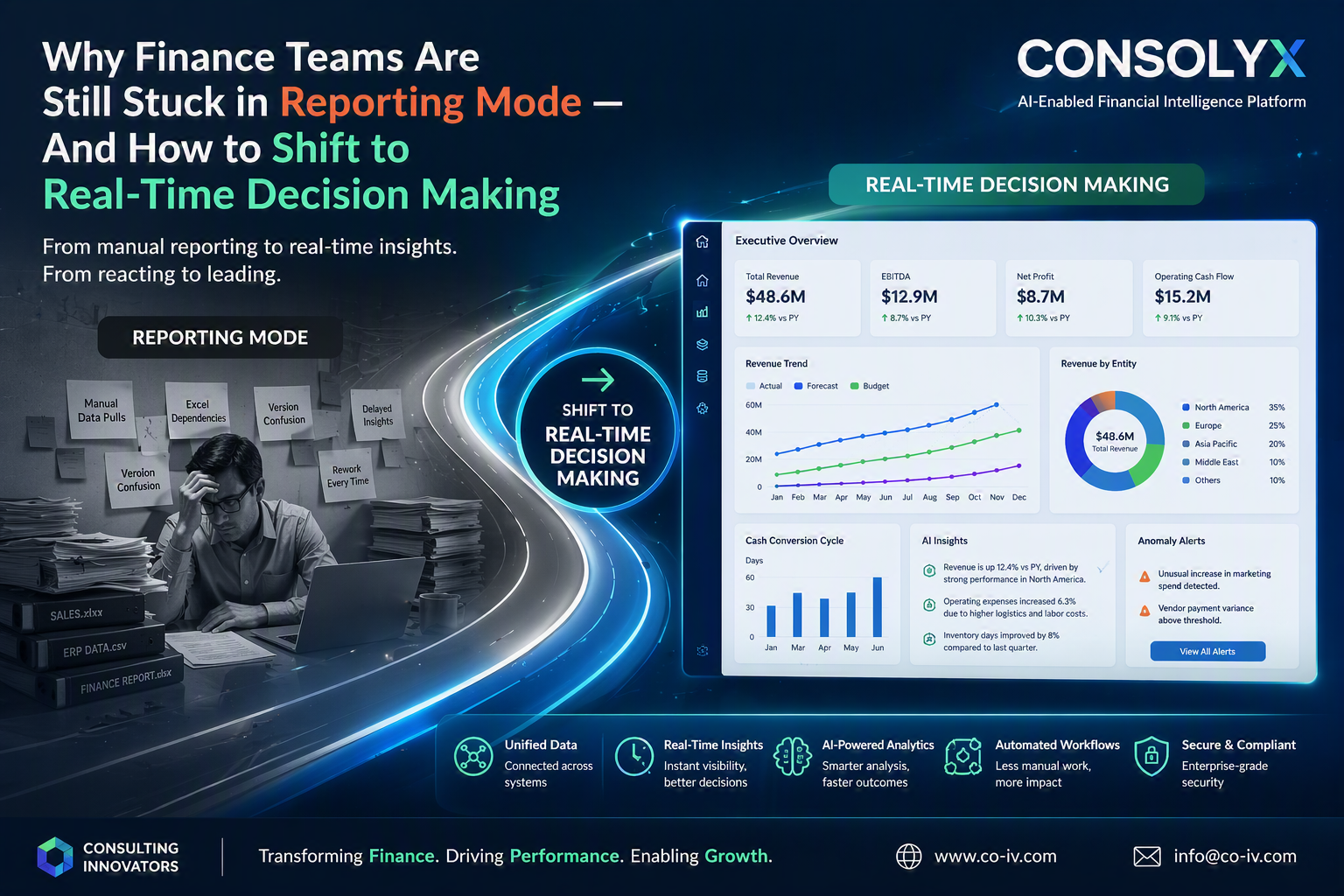
Why Finance Teams Are Still Stuck in Reporting Mode — And How to Shift to Real-Time Decision Making
Finance teams are working harder than ever, yet many remain stuck in manual reporting processes. This article explores why reporting mode still dominates and how organizations can move toward real-time, insight-driven decision making through better data, workflows, and AI-enabled systems.
Why Finance Teams Are Still Stuck in Reporting Mode — And How to Shift to Real-Time Decision Making
Across many organizations, finance teams are working harder than ever. They are expected to close faster, report more accurately, support planning, respond to management queries quickly, and increasingly provide forward-looking insight.
Yet the reality inside many finance functions is very different.
Highly capable professionals spend a large part of their time pulling data from different systems, cleaning files, checking numbers, updating spreadsheets, and reformatting reports. By the time the numbers are ready, the opportunity to act may already be gone.
The problem is not a lack of talent.
It is not even a lack of data.
The real issue is that many finance teams are still operating in reporting mode, instead of decision mode.
What Does “Reporting Mode” Really Mean?
Reporting mode is when finance is focused mainly on producing numbers rather than using them.
It is a cycle that looks like this:
- Extract data from multiple systems
- Combine everything in spreadsheets
- Validate and reconcile numbers
- Adjust formats for reporting
- Update management packs
- Repeat when data changes
This creates a reactive environment where teams are constantly catching up instead of getting ahead.
Why Are Finance Teams Still Stuck Here?
Even with modern systems like ERP, BI tools, and dashboards, the problem still exists. That’s because the issue is not just technology — it is how systems, processes, and workflows are connected.
1. Disconnected systems
Finance, operations, HR, and supply chain data often sit in separate tools, with limited integration.
2. Heavy reliance on spreadsheets
Excel becomes the bridge between systems, which makes processes difficult to scale and maintain.
3. Legacy processes
Many reporting structures were designed years ago and have not evolved with business speed and complexity.
4. Lack of data confidence
If management cannot fully trust system-generated reports, finance teams revert to manual validation.
5. Focus on formatting over insight
Significant time is spent aligning presentation, rather than analyzing what the numbers actually mean.
The Hidden Cost of Reporting Mode
This issue goes beyond inefficiency.
- Decisions are delayed
- Insights arrive too late
- Forecasts are adjusted after the fact
- Opportunities are missed
- Costs remain hidden until it is difficult to act
There is also a human cost.
Finance professionals want to analyze, guide, and influence decisions — not spend most of their time fixing spreadsheets and rechecking numbers.
What Needs to Change?
Moving to real-time decision making is not about faster reports alone. It requires a shift in how finance operates.
1. Build a Connected Data Foundation
Data from ERP, operations, HR, and other systems should flow into one structured environment. This reduces the need to rebuild reports every cycle.
2. Standardize Workflows
Core elements like approvals, mappings, and consolidation logic should be stable and automated. This ensures consistency and reduces rework.
3. Shift from Static Reports to Live Analysis
Instead of waiting for reports to be prepared, teams should be able to:
- Drill down instantly
- Refresh insights in real-time
- Explore data dynamically
4. Use Automation to Remove Friction
Automation should focus on:
- Data collection
- Reconciliation
- Report updates
- Exception alerts
This frees up time for real analysis.
5. Apply AI Where It Adds Value
AI can support:
- Commentary generation
- Variance analysis
- Forecasting insights
- Pattern recognition
But it should sit on top of strong workflows — not replace them.
Why This Matters Across the Business
When finance shifts from reporting to decision-making:
- Management gets faster insights
- Operations respond sooner to issues
- Inventory levels can be optimized
- Costs become more visible
- ESG and sustainability data becomes easier to track
- Workforce trends are better understood
Finance moves from looking backward to helping shape what happens next.
The Bigger Opportunity
Modern organizations don’t just need faster reporting. They need connected intelligence.
This means:
- Data is unified
- Processes are structured
- Insights are real-time
- Decisions are proactive
This is where AI-enabled financial intelligence platforms are becoming critical — combining consolidation, analytics, and decision support into a single environment.
Conclusion
Finance teams are not stuck in reporting mode because they lack capability.
They are stuck because of fragmented systems, manual workflows, and outdated processes.
The shift forward is clear:
- Connect the data
- Simplify the workflow
- Automate repetitive tasks
- Enhance insight with AI
When this happens, finance becomes more than a reporting function.
It becomes a real-time decision engine for the business.