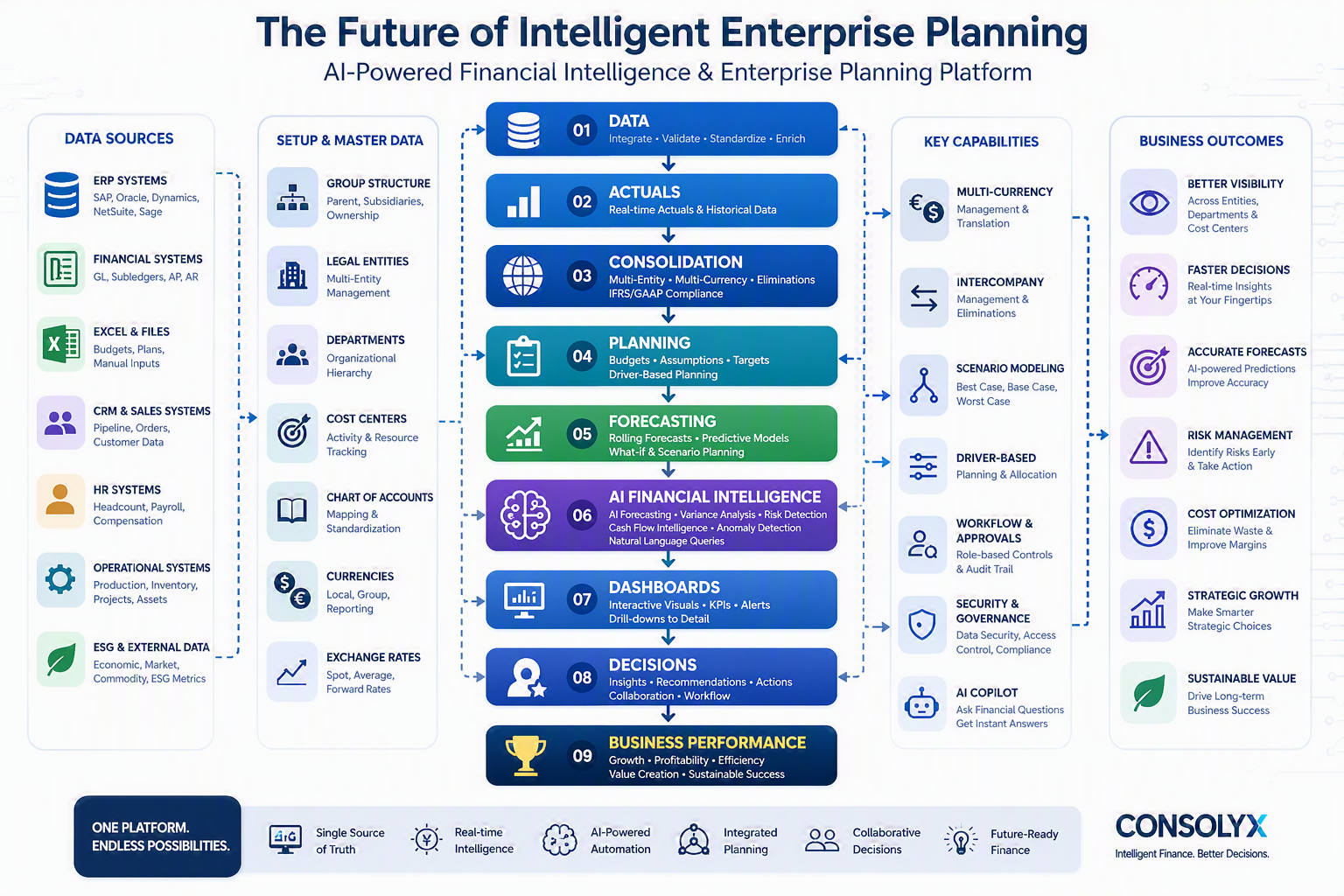
The Future of FP&A: How AI, Connected Planning, and Financial Intelligence Are Redefining Enterprise Performance
Not long ago, finance teams spent most of their time explaining the past. Month-end reports were prepared, variances were analyzed, budgets were reviewed, and management meetings focused on understanding what had already happened. The finance function was largely viewed as the organization’s scorekeeper—a critical role, but one that was often reactive rather than strategic.
Today, that reality is changing rapidly.
Business leaders are operating in a world defined by uncertainty. Economic conditions shift unexpectedly. Exchange rates fluctuate daily. Supply chains face disruption. Customer behavior evolves faster than ever before. New technologies emerge continuously, creating opportunities and risks in equal measure.
In this environment, knowing what happened last month is no longer enough.
The organizations that thrive over the next decade will be those capable of understanding what is happening now, anticipating what may happen tomorrow, and acting before competitors do.
This is where the future of Financial Planning & Analysis (FP&A) begins.
FP&A is evolving from a budgeting and reporting function into the intelligence engine of the modern enterprise—connecting data, planning, forecasting, artificial intelligence, and decision-making into a single ecosystem designed to drive performance.
Finance Is No Longer About Producing Reports
A report can tell you that revenue declined by 8%.
An intelligent finance function can tell you why it happened, which business units contributed to the decline, how foreign exchange rates influenced profitability, what impact it will have on cash flow, and what management should do next.
That difference is profound.
For many years, organizations accepted delays between business activity and financial insight. Transaction data flowed into ERP systems. Finance teams spent days collecting information from multiple entities. Reports were consolidated manually. By the time decision-makers received the information, the business landscape had often changed.
Modern enterprises can no longer afford that delay.
Finance is moving closer to operations, strategy, technology, and executive leadership. Rather than acting as a reporting department, FP&A is becoming the central nervous system of organizational decision-making.
Why Traditional Budgeting Is Reaching Its Limits
Most finance professionals have participated in lengthy annual budgeting cycles.
Departments prepare assumptions.
Spreadsheets circulate through the organization.
Versions multiply.
Meetings increase.
Approvals take weeks.
The final budget is approved.
Then reality changes.
Suddenly a key market slows down. Customer demand shifts. Raw material prices rise. Regulatory requirements change. Exchange rates move significantly. A competitor launches a disruptive product.
Within months, the original budget may no longer reflect business reality.
This does not mean budgets are becoming irrelevant.
It means static planning is becoming insufficient.
Leading organizations are supplementing annual budgets with rolling forecasts, scenario modelling, dynamic assumptions, and real-time planning capabilities. They recognize that agility has become just as important as accuracy.
The question is no longer:
"What is our budget?"
The question is:
"Given what we know today, what should our plan be tomorrow?"
Connected Planning Is Replacing Disconnected Processes
One of the biggest challenges facing modern enterprises is fragmentation.
Actual financial results often reside in one system.
Budgets are maintained somewhere else.
Forecasts sit in spreadsheets.
Dashboards operate independently.
Operational planning takes place in separate tools.
As a result, organizations spend enormous effort reconciling information rather than generating insight.
Connected Planning changes this completely.
Imagine an environment where actual results automatically feed forecasts.
Where forecasts automatically update scenarios.
Where department plans roll into entity plans.
Where entity plans consolidate into group performance.
Where AI continuously analyzes outcomes and identifies emerging risks.
Instead of managing disconnected processes, organizations manage a connected planning ecosystem.
Every decision becomes faster.
Every forecast becomes more relevant.
Every conversation becomes more strategic.
The Growing Challenge of Multi-Entity and Multi-Currency Operations
As organizations expand internationally, complexity grows exponentially.
A group operating across the United Kingdom, Saudi Arabia, the UAE, Pakistan, Ireland, and Malaysia faces challenges that extend far beyond accounting.
Each entity may have:
- Different currencies
- Different regulations
- Different reporting requirements
- Different operational structures
- Different market conditions
Yet executive leadership still requires a single view of performance.
This is where modern FP&A becomes essential.
Future-ready planning environments must provide visibility across the entire group while allowing local management teams to operate effectively within their own markets.
A CFO should be able to move seamlessly from consolidated group EBITDA to the performance of a specific department, cost center, project, region, or legal entity.
This level of visibility transforms decision-making.
Instead of managing complexity, organizations begin leveraging it as a competitive advantage.
Why Actual Data Matters More Than Ever
For decades, planning discussions often began with assumptions.
The future begins with actual data.
The most reliable forecast is rarely built from a blank spreadsheet. It is built from historical performance, operational trends, and real business activity.
Future finance organizations will increasingly use actual results as the starting point for planning.
Revenue trends.
Profitability trends.
Cost behavior.
Seasonal patterns.
Cash flow movements.
Working capital dynamics.
All of these provide valuable signals about future performance.
In many ways, actual data has become one of the most strategic assets within the enterprise.
The better the quality of actual data, the stronger the quality of forecasting, planning, analytics, and AI-driven insights.
Artificial Intelligence Is Becoming the CFO's Digital Copilot
Few technologies have created as much excitement as Artificial Intelligence.
Yet the most significant impact of AI may not be automation.
It may be decision support.
Future finance teams will increasingly rely on AI as a trusted advisor capable of identifying patterns, detecting anomalies, and generating insights at a scale impossible for humans alone.
Imagine opening a dashboard and asking:
"Why did gross margin decline this quarter?"
Instead of manually analyzing dozens of reports, AI immediately identifies:
- Rising production costs
- Currency fluctuations
- Pricing pressure in specific markets
- Changes in customer mix
Now imagine asking:
"What happens if sales decrease by 10% next quarter?"
Within seconds, AI evaluates potential impacts on profit, cash flow, working capital, and liquidity.
The conversation shifts from reporting to decision-making.
This is where AI delivers its greatest value—not by replacing finance professionals, but by making them significantly more effective.
Forecasting Is Becoming Continuous
One of the most important changes taking place within FP&A is the move toward continuous forecasting.
Traditional planning assumes the future can be predicted once or twice a year.
Modern business reality proves otherwise.
Organizations need forecasting processes capable of adapting to change continuously.
New actual results become available.
Market assumptions evolve.
Operational conditions shift.
Customer demand changes.
Future planning systems will automatically absorb these signals and update forecasts accordingly.
This creates a living forecast rather than a static forecast.
The result is greater agility, improved confidence, and faster decision-making.
Driver-Based Planning Connects Strategy with Financial Results
One of the most exciting developments in enterprise planning is the growing adoption of driver-based planning.
Traditional budgeting focuses on financial outcomes.
Driver-based planning focuses on what creates those outcomes.
For example, revenue does not simply appear.
Revenue may be driven by:
- Sales volume
- Customer growth
- Pricing strategy
- Market expansion
- Product mix
Similarly, personnel costs may be driven by:
- Workforce size
- Salary increases
- Hiring plans
- Employee retention
By planning the underlying business drivers, organizations develop a much deeper understanding of future performance.
More importantly, they create a direct connection between strategy and financial outcomes.
Every operational decision can be linked to measurable financial impact.
Cash Flow Is Becoming the New Strategic Metric
Many organizations focus heavily on revenue growth and profitability.
Experienced finance leaders know that neither guarantee success.
Businesses rarely fail because they lack revenue.
They often fail because they run out of cash.
This reality is placing greater attention on cash flow forecasting, liquidity planning, and working capital optimization.
The future of FP&A is not simply about forecasting income statements.
It is about forecasting financial resilience.
Future planning systems will increasingly help organizations answer questions such as:
- What will our cash position look like six months from now?
- How sensitive are we to market changes?
- When might additional funding be required?
- Which customers have the greatest impact on cash flow?
Organizations that master cash flow intelligence will be significantly better positioned to navigate uncertainty.
Dashboards Are Evolving into Decision Intelligence Platforms
Most dashboards today focus on visualization.
The next generation will focus on intelligence.
Showing KPIs is no longer enough.
Decision-makers need context.
They need explanations.
They need recommendations.
Future dashboards will not simply display performance.
They will answer questions.
They will identify risks.
They will highlight opportunities.
They will provide proactive recommendations supported by AI and advanced analytics.
The dashboard of the future will act less like a report and more like a strategic advisor.
Looking Toward 2030
As we look ahead, several trends are likely to redefine the future of FP&A.
Artificial Intelligence will become deeply embedded within finance workflows.
Forecasting cycles will become increasingly continuous.
Planning will become more connected across finance, sales, operations, HR, and supply chain functions.
Driver-based planning will become mainstream.
Scenario planning will become routine rather than exceptional.
And perhaps most importantly, finance teams will spend significantly less time preparing reports and significantly more time influencing decisions.
The finance function will become one of the organization's most valuable strategic assets.
The CFO of the Future
The CFO of the future will not be measured by the number of reports produced.
The CFO of the future will be measured by the quality of decisions enabled.
Tomorrow's finance leaders must combine financial expertise with technology, analytics, data governance, AI, and business strategy.
They will help organizations navigate complexity, manage risk, allocate capital effectively, and identify opportunities for growth.
More than ever before, finance will sit at the center of enterprise transformation.
The Age of Intelligent Enterprise Planning
A new era is emerging.
An era where actual data, planning, forecasting, consolidation, analytics, dashboards, and Artificial Intelligence operate as a connected ecosystem.
An era where finance teams no longer spend most of their time explaining the past.
Instead, they help shape the future.
Organizations that embrace intelligent enterprise planning will gain more than better forecasts.
They will gain clearer visibility, stronger control, faster decisions, improved resilience, and a sustainable competitive advantage.
The future of FP&A is not simply about budgeting.
It is about creating intelligent enterprises capable of transforming data into insight, insight into action, and action into measurable business value.
At CONSOLYX, we believe this transformation has already begun.
For further information about Financial Consolidation, FP&A, Connected Planning, AI-Powered Forecasting, and Financial Intelligence solutions, contact:
📧 info@co-iv.com
🌐 www.co-iv.com