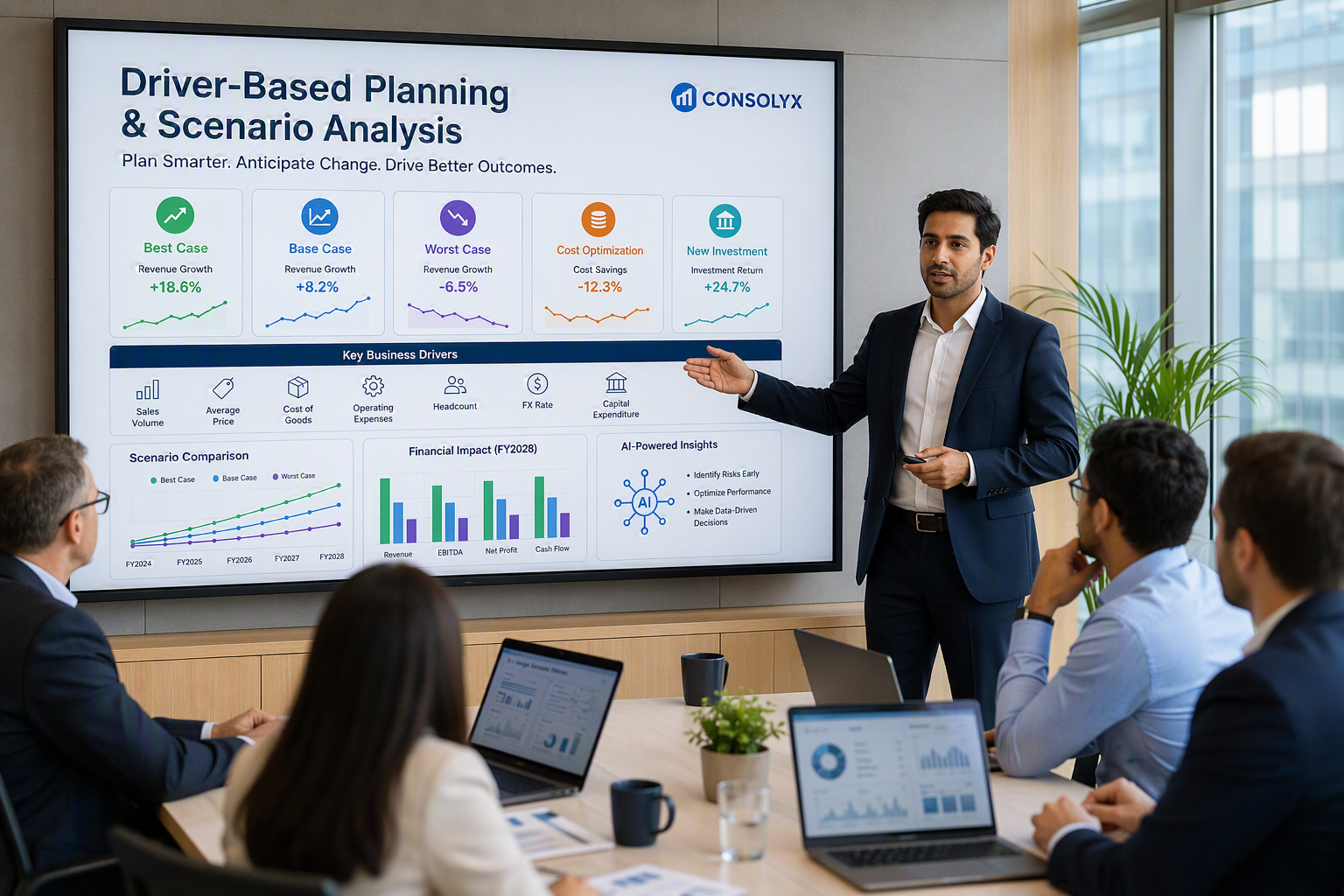
Driver-Based Planning & Scenario Analysis: How Modern Enterprises Improve Forecast Accuracy, Manage Risk, and Accelerate Growth
Traditional budgeting is no longer sufficient in today's volatile business environment. Discover how Driver-Based Planning and Scenario Analysis help enterprises evaluate uncertainty, test strategic decisions, improve forecast accuracy, optimize costs, and support sustainable growth through data-driven financial planning.
Driver-Based Planning & Scenario Analysis: How Modern Enterprises Improve Forecast Accuracy, Manage Risk, and Accelerate Growth
In today's rapidly changing business environment, organizations can no longer rely solely on annual budgets and static Excel models. Economic uncertainty, inflation, foreign exchange volatility, changing customer demand, rising financing costs, and global competition are forcing finance leaders to rethink how planning and forecasting are performed.
Modern organizations require a more agile, intelligent, and data-driven approach to financial planning. This is where Driver-Based Planning and Scenario Planning have become essential capabilities for CFOs, finance teams, FP&A professionals, and business leaders.
Rather than simply reporting historical results, leading enterprises are now using planning systems that help them anticipate future outcomes, evaluate risks, assess opportunities, and make informed business decisions with confidence.
Why Traditional Budgeting No Longer Works
Many organizations still depend on spreadsheets for budgeting and forecasting. While spreadsheets remain useful, they often create significant challenges as companies grow.
Common challenges include:
• Multiple versions of the same budget
• Manual data consolidation
• Limited visibility across departments
• Time-consuming forecasting processes
• Difficulty evaluating alternative business outcomes
• Increased risk of human error
• Slow decision-making during market changes
As businesses become more complex, finance teams need planning tools capable of responding quickly to both risks and opportunities.
What is Driver-Based Planning?
Driver-Based Planning is a modern forecasting methodology where financial results are linked directly to the key operational and financial drivers of the business.
Instead of manually adjusting hundreds of forecast lines, organizations identify the factors that influence performance and use these drivers to automatically update projections.
Common Business Drivers Include:
✅ Sales Volume
✅ Product Pricing
✅ Customer Growth
✅ Production Capacity
✅ Headcount
✅ Employee Costs
✅ Raw Material Costs
✅ Exchange Rates
✅ Interest Rates
✅ Capital Investments
✅ Market Expansion Initiatives
When these drivers change, associated forecasts automatically recalculate across:
- Revenue
- Expenses
- Profitability
- Cash Flow
- Balance Sheet
- Consolidated Financial Statements
This creates a dynamic planning environment where businesses can quickly evaluate future outcomes.
What is Scenario Planning?
Scenario Planning allows organizations to model different business conditions and understand the financial impact of potential future events.
Instead of relying on a single forecast, management can prepare multiple scenarios and compare outcomes before making strategic decisions.
This approach enables organizations to move from reactive decision-making to proactive strategic planning.
Key Scenario Types Used by Leading Enterprises
1. Base Case Scenario
The Base Case represents the most realistic forecast based on current assumptions and expected market conditions.
Example
A manufacturing group expects:
- Revenue Growth: 8%
- Inflation: 5%
- Stable Currency Environment
The Base Case becomes the organization's primary operating plan and management benchmark.
Enterprise Benefit
Provides a realistic financial roadmap and performance benchmark.
2. Best Case Scenario
The Best Case assumes favorable market conditions and stronger-than-expected business performance.
Example
- Strong customer demand
- Higher sales growth
- Improved operational efficiency
- Lower financing costs
Enterprise Benefit
Helps management evaluate expansion opportunities and growth investments.
3. Worst Case Scenario
The Worst Case evaluates potential downside risks.
Example
- Revenue decline
- Inflation increases
- Market contraction
- Customer losses
Enterprise Benefit
Supports risk mitigation strategies and business continuity planning.
4. Revenue Growth Scenario
This scenario evaluates the impact of accelerated sales growth.
Example
If revenue increases by 20%, organizations can assess:
- Resource requirements
- Staff expansion
- Working capital needs
- Inventory requirements
- Profitability impact
Enterprise Benefit
Supports growth planning and resource optimization.
5. Cost Optimization Scenario
Organizations frequently seek opportunities to improve efficiency while maintaining operational effectiveness.
Example
- Procurement savings
- Process automation
- Headcount optimization
- Administrative expense reductions
Enterprise Benefit
Improves profitability and operational performance.
6. New Investment Scenario
Before committing capital, organizations need visibility into future returns.
Example
- New manufacturing facility
- Technology investment
- AI initiatives
- Market expansion programs
Enterprise Benefit
Supports capital allocation and investment decision-making.
7. Debt Financing Scenario
Debt remains an important source of business funding.
Example
Organizations evaluate:
- Additional borrowing requirements
- Interest rate sensitivity
- Debt servicing capacity
- Cash flow impact
Enterprise Benefit
Improves treasury management and liquidity planning.
8. Equity Injection Scenario
This scenario evaluates new shareholder investments or funding rounds.
Example
- New investor participation
- Improved liquidity
- Growth capital availability
- Balance sheet strengthening
Enterprise Benefit
Supports strategic fundraising initiatives and expansion plans.
9. FX Devaluation Scenario
For multinational organizations, exchange rate fluctuations can significantly affect profitability.
Example
A 15% currency depreciation may increase:
- Import costs
- Foreign debt obligations
- Procurement expenses
Enterprise Benefit
Strengthens foreign exchange risk management and hedging decisions.
10. Acquisition Scenario
Organizations often evaluate mergers and acquisitions as part of strategic growth initiatives.
Example
Finance teams can analyze:
- Revenue synergies
- Cost savings
- Integration costs
- Goodwill implications
- Consolidated results
Enterprise Benefit
Supports informed M&A decision-making.
11. Disposal Scenario
Organizations occasionally divest business units or underperforming assets.
Example
Management can evaluate:
- Cash proceeds
- Profitability impact
- Operational efficiencies
- Future investment requirements
Enterprise Benefit
Supports portfolio optimization and value creation.
12. Custom Scenario
Every organization faces unique strategic challenges and opportunities.
Examples include:
- New market entry
- ESG initiatives
- Regulatory changes
- Tax reforms
- New product launches
- Digital transformation programs
Enterprise Benefit
Provides complete flexibility for business-specific planning requirements.
Real-World Enterprise Applications
Manufacturing Companies
Manufacturers frequently use Driver-Based Planning to assess:
- Demand fluctuations
- Material cost changes
- FX exposures
- Production capacity utilization
Result:
✅ Improved forecast accuracy
✅ Better inventory management
✅ Stronger profitability control
Financial Institutions
Banks and financial organizations use scenarios to evaluate:
- Interest rate changes
- Economic downturns
- Portfolio growth
Result:
✅ Better capital planning
✅ Enhanced risk management
✅ Stronger regulatory compliance
Retail & Consumer Businesses
Retail groups apply planning models to evaluate:
- Store expansion
- Customer demand fluctuations
- Pricing strategies
- Supply chain risks
Result:
✅ Better investment decisions
✅ Improved cash flow visibility
✅ Increased profitability
The Strategic Value of Driver-Based Planning
Organizations that implement structured planning processes gain significant advantages:
✅ Faster Budget Cycles
✅ Better Forecast Accuracy
✅ Improved Decision Making
✅ Enhanced Risk Management
✅ Increased Financial Visibility
✅ Greater Organizational Agility
✅ Stronger Executive Confidence
✅ Improved Resource Allocation
Instead of spending weeks updating spreadsheets, finance teams focus on analyzing business performance and supporting strategic decisions.
CONSOLYX Planning & Forecasting Platform
The CONSOLYX Planning & FP&A Workspace is designed to help organizations transform planning, forecasting, and decision-making through a modern cloud-based platform.
Key capabilities include:
✅ Driver-Based Planning
✅ Scenario Modeling
✅ Budgeting & Forecasting
✅ Rolling Forecasts
✅ Multi-Entity Planning
✅ Multi-Currency Forecasting
✅ Revenue & Cost Simulations
✅ FX Impact Analysis
✅ Investment Planning
✅ Consolidated Reporting
✅ AI-Powered Insights
✅ Executive Dashboards
✅ Financial Consolidation Integration
By combining planning, forecasting, reporting, analytics, and AI-powered insights in a single environment, organizations can move beyond traditional budgeting and develop a truly strategic finance function.
Conclusion
The future belongs to organizations that can anticipate change before it happens. Driver-Based Planning and Scenario Analysis provide finance leaders with the tools required to navigate uncertainty, evaluate opportunities, and make better decisions with confidence.
Whether managing growth, controlling costs, evaluating investments, responding to market disruptions, or planning future expansion, modern enterprises need a planning platform that is flexible, intelligent, and collaborative.
CONSOLYX empowers finance teams to transform budgeting and forecasting into a strategic decision-making process, enabling faster insights, stronger financial performance, and sustainable long-term growth.