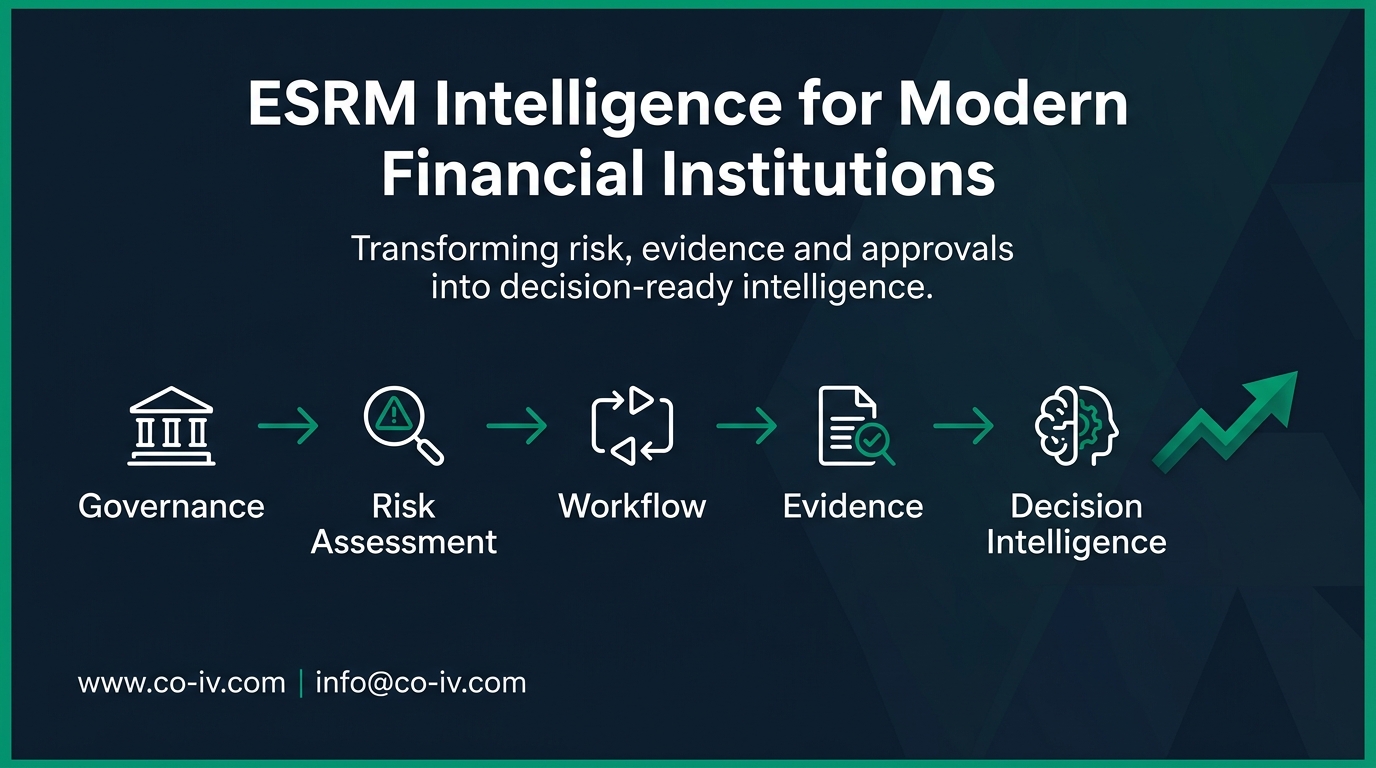
ESRM Software for Banks: From Manual Processes to Governed Risk Intelligence
How CONSOLYX connects environmental and social due diligence, risk decisions, approvals, evidence, monitoring and reporting within one controlled operating environment.
The Real ESRM Challenge
Environmental, social and climate-risk expectations are becoming part of mainstream financial decision-making. Yet many banks still coordinate Environmental and Social Risk Management through spreadsheets, emails, disconnected documents, repeated data entry and manually followed approvals. That creates a familiar problem for risk, credit, sustainability and compliance teams: the policy may exist, but the operating process is too fragmented to give leaders a reliable view of status, evidence, accountability and exceptions.
ESRM software for banks is the operating layer that helps convert approved ESRM policy into controlled action. It connects origination, applicability assessment, exclusion screening, environmental and social due diligence, risk categorisation, conditions and action plans, approvals, disbursement controls, monitoring, evidence and reporting. The objective is not simply to produce another regulatory report. The more important requirement is to make ESRM visible, traceable and usable in real credit and portfolio decisions.
CONSOLYX enters at this point: after the institution has defined its policy, methodology and authority structure, but needs a practical way to execute them consistently across cases, teams, approvals and reporting lines. It is positioned as a governed ESRM operating environment, not as a substitute for expert judgement, institutional accountability or regulatory interpretation.
From Manual Administration to Governed Risk Intelligence
The transition is not only about digitising forms. It is about replacing informal coordination with an operating model where data, decisions, evidence and responsibilities remain connected from the first screening question to the final monitoring action.
|
Manual Administration Spreadsheets and email coordination, repeated data entry, disconnected evidence, informal follow-up, inconsistent visibility and limited portfolio visibility. |
Governed ESRM Structured data capture, configurable methodologies, role-based workflow, approval controls, linked evidence, monitoring alerts, decision history and portfolio reporting. |
A Connected ESRM Lifecycle
Borrower and facility onboarding → Applicability and exclusion screening → ESDD → Risk categorisation → Conditions and approvals → Clearance → Monitoring → Reassessment
The principal value is continuity. Each stage works from a controlled case record rather than separate spreadsheets, emails and files. A borrower profile, facility purpose, sector exposure, location, evidence, reviewer comments, conditions precedent and monitoring actions can remain connected throughout the credit lifecycle.
Using approved methodologies, a case may be categorised as High Risk, Medium Risk or Low Risk. Corrective action plans, covenants and conditions precedent can then be linked to the decision record, allowing credit and monitoring teams to understand not only the rating, but the obligations that follow from it.
Transparent Decisions, Accountable Workflow and Evidence
ESRM classification should never operate as an unexplained black box. An authorised decision-maker should be able to see the methodology and version applied, the responses and risk drivers behind the result, the supporting evidence, the reviewer and approving authority, the conditions imposed, unresolved actions and the reassessment date.
Workflows can reflect configurable role examples such as Relationship Manager, ESRM or E&S Risk Officer, Head of Green Banking, Credit Risk, Credit Approving Authority, Credit Administration and Monitoring Team. Maker-checker controls, segregation of duties, returned cases, escalation, exceptions, approval history and turnaround monitoring help turn policy into accountable execution.
|
Control Gate |
Purpose |
Typical Validation |
Decision Impact |
|
Screening Gate |
Confirm readiness for E&S review. |
Applicability, exclusion checks and baseline evidence. |
Proceed, return, escalate or reject. |
|
ESRM Clearance Gate |
Confirm ESDD and mitigation requirements. |
Risk category, action plan and reviewer sign-off. |
Ready for credit consideration, subject to conditions. |
|
Credit Approval Gate |
Reflect E&S findings in the credit decision. |
Authority approval, conditions and exceptions. |
Credit terms include approved ESRM obligations. |
|
Disbursement Gate |
Verify conditions precedent before drawdown. |
Clearance, documents, open items and evidence. |
Clearance or block status returned where integrated. |
Where CONSOLYX is integrated with an institution’s loan origination or core banking environment, the connected system can use the returned clearance or block status as an enforcement control. CONSOLYX governs the status, decision logic and supporting evidence; the institution must implement and validate the external enforcement point within its approved technology architecture.
Evidence may include permits, licences, EIA or IEE documents, site visits, laboratory reports, consultant studies, legal confirmations, action-plan closure evidence, conditions-precedent evidence, monitoring reports and incident records. Source-to-decision traceability should make it clear what was submitted, who submitted it, which methodology applied, who reviewed it, what was approved, which conditions remained and when reassessment became due. The capability is designed to support audit, assurance and regulatory review without claiming external certification or endorsement.
Responsible AI may assist users with document review, gap detection, anomaly identification, commentary and guided analysis. Formal risk categorisation, clearances and approvals must remain governed by approved methodologies, deterministic decision rules and accountable human review.
Monitoring, Climate Risk and Portfolio Intelligence
ESRM continues after approval and disbursement. Monitoring schedules, action-plan follow-up, covenant tracking, permit expiry, site observations, incidents, reassessment and renewal triggers all need clear ownership. This gives management a current view of overdue actions, unresolved incidents, expiring approvals, breached conditions and cases requiring reassessment.
Climate-risk management becomes more valuable when it is connected to financial exposure and portfolio decision-making. Physical climate risk, transition risk, facility and geographic exposure, risk scenarios, mitigation actions and portfolio monitoring help leaders move beyond narrative disclosure and towards practical supervision of material risk.
Relationship Managers need clear case status and required actions. ESRM teams need assessment, evidence and monitoring information. Credit functions need conditions, clearance status and approval history. Senior management and boards need portfolio exposure, concentrations and exceptions. Regulators and auditors need methodology, evidence, approvals and traceability.
Security, Integration and Adaptable Regulatory Alignment
CONSOLYX uses a Microsoft Azure-enabled architecture that can support Azure SQL, Microsoft Entra ID, role-based access, single sign-on, multifactor authentication, audit logging and secure integration patterns, subject to the institution’s implemented configuration, licensing, policies and security validation.
The operating environment complements existing systems of record rather than automatically replacing them. Data may be received through secure APIs, controlled uploads, database connections, ERP systems, loan origination systems, core banking systems and approved Excel or CSV templates.
For Pakistan, CONSOLYX can be configured for financial institutions around the institution’s approved interpretation and implementation of State Bank of Pakistan ESRM requirements, green banking workflow expectations and internal credit policies. The architecture is country-agnostic and can be adapted for other jurisdictions, institutional policies, risk thresholds, questionnaires, authority structures, workflows and reporting formats. Banks remain the primary audience, while development finance institutions, insurers, investment institutions and specialised lenders may use adjacent capabilities with appropriate configuration and validation.
Why This Matters
· More consistent application of approved policy.
· Clearer ownership and segregation of duties.
· Stronger evidence and decision traceability.
· Earlier visibility of blocked, overdue or escalating cases.
· Better portfolio-level risk oversight.
· Greater readiness for management, board and regulatory review.
Implementation begins with the institution’s approved policy, methodology, roles, thresholds, data sources, document requirements, integrations, workflow and reports. Representative cases should be used to validate classifications, routing, approvals, evidence, reporting and user experience before production deployment. Implementation scope and sequencing should be determined after reviewing policy complexity, integrations, data readiness and governance approvals.
Future Outlook and Call to Action
The future of ESRM lies in connecting policy, evidence, accountability and financial decision-making. Institutions making this transition will be better positioned to identify material risks earlier, maintain stronger oversight and demonstrate how environmental and social considerations influence real decisions.
CONSOLYX helps institutions build that capability through configurable methodology, structured data capture, transparent assessment, role-based workflow, evidence, monitoring and executive intelligence. The operating model can be adapted for approved requirements in Pakistan and international markets. Used well, ESRM software for banks becomes less about compliance administration and more about disciplined, evidence-based decision support.
Request an ESRM walkthrough to explore your institution’s policy alignment, workflow, integration and reporting requirements.