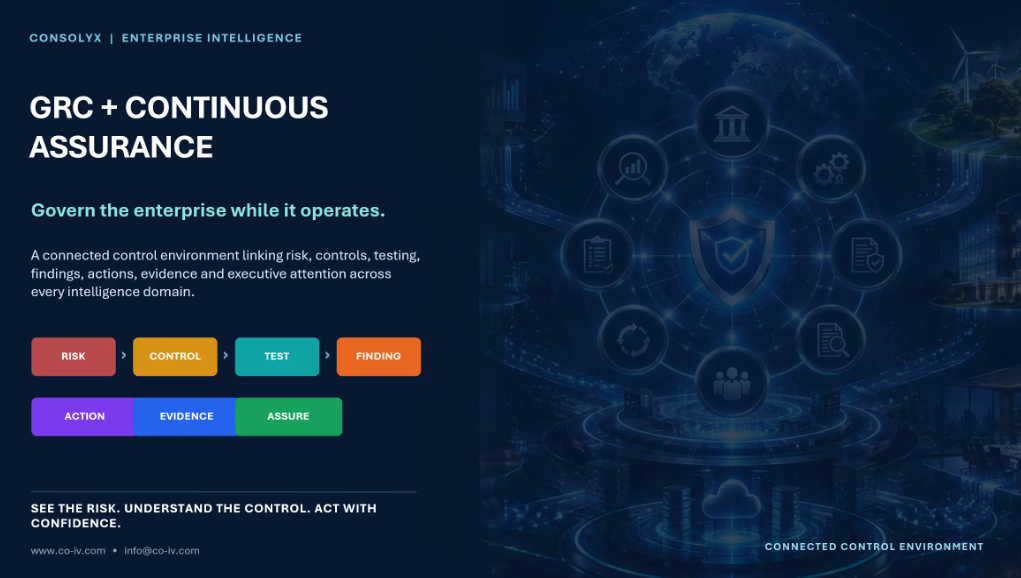
Enterprise GRC and Continuous Assurance:
From Risk Registers to Real-Time Control Intelligence A large-enterprise operating model for connected risk, controls, evidence and executive decision-making
GOVERNANCE, RISK & COMPLIANCE
Enterprise GRC and Continuous Assurance:
From Risk Registers to Real-Time Control Intelligence
A large-enterprise operating model for connected risk, controls, evidence and executive decision-making

Enterprise article and illustrative Singapore case study
Consulting Innovators | CONSOLYX
INTERNAL PUBLISHING METADATA — DO NOT COPY INTO ARTICLE BODY
|
Element |
Recommended Copy |
|
SEO title |
Enterprise GRC and Continuous Assurance: From Risk Registers to Real-Time Control Intelligence |
|
Meta description |
How large enterprises can connect governance, risk, controls, compliance, evidence and audit trails across operations, finance, ESG and AI-enabled decision-making. |
|
Primary keyword |
enterprise GRC platform |
|
Secondary keywords |
continuous assurance; governance risk and compliance; internal controls automation; enterprise risk management; audit trail; compliance management; ESG governance; control testing; risk intelligence |
|
Suggested URL slug |
/enterprise-grc-continuous-assurance-control-intelligence |
|
LinkedIn hook |
A failed control should not require three meetings, four spreadsheets and an audit request before management can see it. |
Recommended audience: Board members, Audit and Risk Committees, CFOs, Chief Risk Officers, Chief Compliance Officers, Internal Audit leaders, controllers, sustainability leaders and enterprise transformation teams.
Executive Summary
Large organisations rarely suffer from a lack of policies, controls or risk registers. The more common failure is fragmentation: operational transactions, financial reporting, ESG obligations, control testing, findings, remediation and audit evidence are maintained in different systems, on different calendars and under different ownership models.
The result is a dangerous gap between formal governance and operational reality. Management may receive more reports, yet still lack one governed view of which risks are escalating, which controls have failed, which obligations are overdue, who owns remediation and whether the response can be evidenced.
Continuous assurance addresses that gap by connecting the full control chain: risk, control, test, finding, action, evidence, assurance and executive decision. The objective is not to replace human judgement or Internal Audit. It is to make control status, ownership, exceptions and evidence continuously visible across the enterprise.
1. The Enterprise GRC Problem Is Not the Register
In a complex group, the same business event can have operational, financial, regulatory, sustainability and reputational consequences. A supplier bank-account change may begin in procurement, move through accounts payable and treasury, affect cash controls, generate an audit exception and trigger compliance or fraud-risk escalation. If each function records only its own part of the event, the organisation has documentation but not control intelligence.
|
Fragmented Model |
Enterprise Consequence |
|
Risks maintained separately from transactions |
Risk exposure is updated after the event rather than as part of the workflow. |
|
Control tests stored in spreadsheets |
Management cannot reliably see the latest control effectiveness across entities and modules. |
|
Findings and actions tracked in email |
Ownership, ageing and escalation become inconsistent. |
|
Evidence stored in folders |
Assurance teams reconstruct the control story instead of reviewing a governed evidence chain. |
|
Compliance obligations managed independently |
Due dates, applicability and control coverage can diverge. |
|
ESG, finance and operations use different taxonomies |
Board reporting presents multiple interpretations of the same enterprise performance. |
2. The Operating Model: GRC as an Enterprise Control Layer
A modern GRC architecture should not sit beside the business as another specialist application. It should operate across the business as a governed control layer. Every material workflow should be able to determine whether a save is permitted, whether approval is required, which control applies, what evidence must be retained, what exception was raised and how the full event is recorded in the audit trail.

|
Control Stage |
Enterprise Question |
Decision Output |
|
Risk |
What could prevent the objective or create loss, non-compliance or misstatement? |
Prioritised exposure, owner and treatment. |
|
Control |
What should prevent, detect or correct the risk? |
Approved control design and frequency. |
|
Test |
Did the control operate as designed? |
Pass, fail, exception and evidence. |
|
Finding |
What deficiency or breach was identified? |
Severity, cause and accountable owner. |
|
Action |
What must change, by when and by whom? |
Remediation plan, due date and escalation. |
|
Evidence |
Can the response be proven? |
Controlled artefact, lineage and approval history. |
|
Assurance |
Can management and assurance functions rely on the control environment? |
Control posture and residual risk. |
|
Decision |
What requires executive intervention? |
Prioritised management attention. |
3. Practical Use Case: Supplier Payment Governance
Consider a multi-entity industrial group processing supplier payments across several jurisdictions. The group has delegated authority limits, payment-run approvals, bank reconciliation controls and local compliance obligations. The critical risk is not simply an incorrect payment. It is the possibility that master-data changes, payment approval, reconciliation, evidence and remediation are disconnected.
|
Event |
Connected GRC Response |
Executive Visibility |
|
Supplier bank details changed |
Maker-checker approval, verification evidence and segregation-of-duties rule are triggered. |
Unapproved or conflicting changes are visible before payment. |
|
Payment run prepared |
Authorisation threshold and approval route are applied by entity, node and role. |
Pending and overdue approvals are visible. |
|
Bank reconciliation control fails |
Control test failure creates a finding linked to the control and affected process. |
CFO and control owners see severity, ageing and exposure. |
|
Corrective action assigned |
Owner, due date, status and supporting evidence are governed. |
Overdue remediation enters management escalation. |
|
Control retested |
Retest result and new evidence remain linked to the original finding. |
Residual risk and closure decision are traceable. |
4. Illustrative Singapore Enterprise Case Study
|
Case-study status: This is an illustrative scenario based on a synthetic demonstration environment. It is not presented as a named customer deployment. |
A Singapore-headquartered industrial and retail group operates manufacturing, distribution and retail entities across multiple jurisdictions. Core transactions are processed through a combination of ERP applications, spreadsheets and local workflows. Finance, procurement, sustainability, compliance and Internal Audit each maintain separate registers and evidence repositories.
The trigger event
A monthly supplier payment-run sign-off becomes overdue. In parallel, the bank and payment reconciliation control fails testing. The control failure produces a high-severity finding, an action is assigned, and the next control test remains due. Without a connected control model, these facts would be split across procurement, finance, audit and compliance records.
The connected response
|
Dashboard Signal |
Illustrative Status |
Management Meaning |
|
Critical / high risks |
1 |
A material risk requires active ownership and treatment. |
|
Overdue obligations |
1 |
A required governance activity has passed its due date. |
|
Failed controls |
2 |
The latest tests for active controls have failed. |
|
Open findings |
3 |
Deficiencies remain open, in progress or remediated pending closure. |
|
Overdue actions |
1 |
At least one corrective action requires escalation. |
|
Evidence items |
321 |
Evidence is available across ESG, GRC and reconciliation repositories. |
|
ESG governance events |
179 |
Validation, calculation, approval and freeze events form a governed history. |
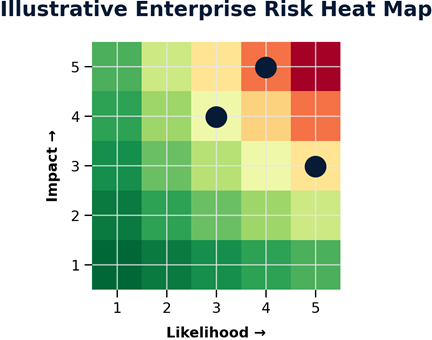
Illustrative heat map for management prioritisation; dots indicate example open-risk positions.
The important outcome is not the number of dashboard cards. It is the ability to move from a risk signal to the relevant obligation, control, latest test, finding, action, evidence and audited activity without rebuilding the narrative manually.
5. What the Board, CFO and Audit Committee Actually Need
|
Executive Question |
Required Intelligence |
|
What requires attention now? |
Critical and high risks, failed controls, overdue obligations and ageing actions. |
|
Where is the exposure concentrated? |
Risk heat maps by entity, node, process, jurisdiction and domain. |
|
Are controls working? |
Latest test results, failure trends, exceptions and coverage by module. |
|
Who owns remediation? |
Named owner, due date, status, escalation path and retest requirement. |
|
Can management prove the response? |
Evidence, approvals, timestamps, lineage and unified audit trail. |
|
Is the control environment improving? |
Six-month trend, recurrence, ageing and residual-risk movement. |
|
Does ESG governance connect to enterprise control? |
Approved calculations, regulatory obligations, evidence and disclosure workflow. |
6. GRC Across the Enterprise
The strategic distinction is that GRC should govern the modules where decisions and transactions occur, not only the registers where risks are documented.
|
Enterprise Domain |
Examples of Embedded Governance |
|
Enterprise Operations |
P2P approvals, supplier-master controls, O2C credit controls, payroll approvals, asset controls, treasury and reconciliations. |
|
Financial Intelligence |
Period close, journal approval, consolidation adjustments, foreign-exchange methodology, eliminations and reporting lineage. |
|
FP&A |
Budget ownership, forecast approvals, scenario governance, assumptions, overrides and variance commentary. |
|
Sustainability Intelligence |
ESG calculations, emission factors, climate-risk methodology, obligations, evidence, assurance and disclosure approval. |
|
Relationship Intelligence |
Opportunity approval, client onboarding, communications, document ownership and relationship activity. |
|
Reporting & AI |
Role-based access, approved data context, narrative review, exception escalation and human-governed decision support. |
7. Singapore Context: Governance, Climate and Assurance
Singapore’s governance and sustainability environment reinforces the need for connected ownership, control, evidence and disclosure. Singapore’s sustainability reporting roadmap takes a climate-first approach, with phased requirements for SGX-listed companies and large non-listed companies. The Monetary Authority of Singapore also emphasises effective governance, robust risk management and meaningful disclosure of environmental risks for financial institutions. These developments increase the importance of traceable data, approved methodologies, evidence retention and defensible management oversight. [1][2][3]
For large Singapore-based groups, the design objective should therefore extend beyond a disclosure tool. The control environment should connect entity structures, operational workflows, finance, climate and ESG calculations, obligations, control testing, findings and Board reporting through one governed chain.
8. AI in GRC: Explain, Detect and Prioritise
AI can materially improve management attention when it operates on governed data. Useful applications include explaining control failures, detecting unusual patterns, summarising recurring findings, identifying overdue obligations, drafting management commentary and prioritising actions. However, AI should not become the control owner, approve its own output or make material compliance decisions without authorised human review.
|
AI Contribution |
Required Guardrail |
|
Explain a control failure |
Source data, control definition and test evidence must remain traceable. |
|
Detect anomalies or recurrence |
Thresholds and review responsibilities must be approved. |
|
Prioritise findings and actions |
Severity and escalation methodology must remain governed. |
|
Draft Board or committee narrative |
Management review and approval remain mandatory. |
|
Answer natural-language questions |
Responses must inherit role access and authorised data context. |
9. Implementation Blueprint for a Large Enterprise
|
Phase |
Focus |
Key Deliverables |
|
1. Governance blueprint |
Objectives, accountability and scope |
Risk taxonomy, governance model, committee structure and reporting outcomes. |
|
2. Control architecture |
Risk-control-obligation mapping |
Control library, ownership, test plans, evidence standards and escalation rules. |
|
3. Platform configuration |
Workflow and role implementation |
Gated saves, maker-checker approvals, role access, due dates and audit trail. |
|
4. Domain integration |
Connect operational and intelligence modules |
P2P, finance, FP&A, sustainability, reporting and relationship-control coverage. |
|
5. UAT and assurance readiness |
Test end-to-end scenarios |
Failures, findings, remediation, retesting, evidence retrieval and management packs. |
|
6. Continuous assurance |
Operate, monitor and improve |
Trends, ageing, recurring failures, coverage gaps and executive action. |
A successful programmed should begin with one material process, such as supplier payment governance, financial close, climate-data approval or regulatory obligation management. The objective is to prove the full control chain before scaling across every module and jurisdiction.
10. The Strategic Shift
The future of enterprise GRC is not another risk register, another annual controls exercise or another dashboard disconnected from workflow. It is a control system that operates with the enterprise: governing saves and approvals, linking risk to controls, converting failed tests into findings and actions, retaining evidence, supporting assurance and presenting management with the issues that require a decision.
When the control chain is connected, leadership no longer waits for teams to assemble the story. The story already exists in the governed record.
|
FROM DOCUMENTING COMPLIANCE AFTER THE EVENT |
About CONSOLYX
CONSOLYX is an AI-powered Enterprise Intelligence Platform connecting Enterprise Operations, Financial Intelligence, FP&A, Sustainability Intelligence, Relationship Intelligence, GRC and Continuous Assurance, Executive Reporting and human-governed AI decision support within one controlled environment. The platform is designed to complement established ERP landscapes or support a broader end-to-end operating model where required.
Website: www.co-iv.com | Email: info@co-iv.com